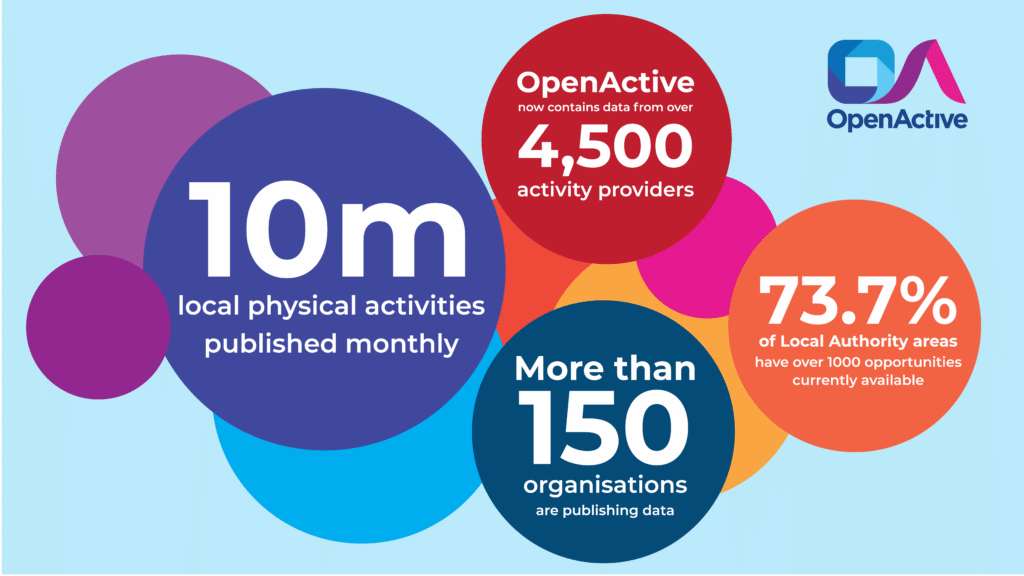
In September last year, we announced further funding from Sport England for an extension of the project’s current phase, helping to align OpenActive with the ambitions of the 10-Year Health Plan for England.
First launched in 2016, OpenActive aims to help people find local exercise opportunities more easily by making the data about these opportunities simple to access, use and share as open data.
Stewarded by the Open Data Institute (ODI), OpenActive is vital to Sport England’s long-term strategy Uniting the Movement, as the challenge of finding information about local opportunities to be active is a persistent barrier to those people and communities already facing inequalities in activity levels.
As 2026 gets well underway, we take a look at the OpenActive story so far and the priorities for the year ahead.
The next 18 months
The OpenActive initiative is entering an exciting new phase, focused on maturing our technical infrastructure and ensuring that open data about physical activity can be used effectively to get more people active. We’ve set ambitious targets, both in the short and long-term, to achieve this.
Our work over the next 18 months is guided by three interconnected key milestones to ensure OpenActive is sustainable, accessible, and integrated across the health and physical activity sectors.
Enhancing Data for All. Our first major goal is to evolve the OpenActive technical infrastructure. This evolution will focus on making it easier and more scalable for a diverse range of organisations to publish open data about sport and physical activity, including both indoor and outdoor opportunities.
We set ourselves the ambitious goal to make publishing data about physical activity opportunities, and aggregating it, as easy as possible, even for non-technical people and with limited resources. A core focus during this period will be to significantly improve the quality of published data concerning accessibility requirements, ensuring more people can find activities truly suited to their needs.
Linking Activity to Health. Building on improved data quality, by October 2026 we aim to make OpenActive an essential tool for the health sector. By this time, our infrastructure will be capable of enabling healthcare professionals to easily signpost patients to local physical activity opportunities that are suitable for specific health needs and conditions. This is a crucial step in cementing the link between open data, physical activity, and public health outcomes.
Sustainability and Community. Our long-term goal is to secure the future of the initiative. By June 2027, OpenActive will have a robust technical infrastructure and a strong, effective governance model supported by an engaged community of contributing organisations. This structure will be designed to preserve the open nature of the initiative while being able to attract sustainable funding or generate revenue to continue its maintenance and evolution.
Our priorities for early 2026
To achieve these long-term goals, we are prioritising several critical actions in the first part of 2026:
- Maintaining Excellence: We are committed to ensuring the OpenActive infrastructure is well-maintained and secure.
- Improving Data Flexibility: We are enabling organisations to list activities that do not have fixed, timed events such as ongoing club memberships, making the data more comprehensive.
- Healthcare integration: we will test the integration of OpenActive data feeds into healthcare settings (GP practices and neighbourhood health centres) to enable healthcare providers and community workers to signpost patients to local activities, helping to shift from cure to prevention.
- Sector Integration: We will ensure OpenActive’s inclusion in the Sport England Public Leisure Contract and Guide, creating a direct incentive for Local Authorities to embed open standards when commissioning management of physical activity programmes in their facilities.
- Driving Sector Insights: The ODI team will be building tools to derive powerful, actionable insights directly from the OpenActive data feeds, helping the sector understand trends and gaps.
- Interoperability: A key mechanism to derive meaningful insights will be achieved by making the OpenActive data infrastructure interoperable with other data initiatives across the sector, ensuring seamless data flow. We will start that by aligning OpenActive opportunity data with Moving Communities participation data and Active Places ID for standardised facility identification.
- Standard Recognition: We are working towards achieving external recognition and adoption of the OpenActive opportunity standard by government and NHS.
By focusing on these immediate priorities, we are laying the essential groundwork to achieve our vision of a sustainable, health-integrated, and highly accessible open data infrastructure for physical activity by 2027.
